Self-Guided Walking Tour of Koreatown LA
2026-03-17 · The RFC Group
Self-Guided Walking Tour of Koreatown LA
Koreatown covers roughly 2.7 square miles of central Los Angeles and packs more history, architecture, food, and culture per block than almost any neighborhood in the city. With a Walk Score of 93, it was built for exploring on foot. This self-guided walking tour takes you from the Wilshire/Western Metro station through Koreatown's most significant landmarks, murals, architectural gems, and food stops. Budget two to three hours depending on how many detours you take for eating — and you will take detours for eating.
Residents of 856 S Gramercy Dr can start this tour from their front door. Everyone else can take the Metro D Line to Wilshire/Western and begin from there.
Before You Start
Wear comfortable walking shoes. The route covers approximately three miles on flat sidewalks. Bring water, sunscreen, and a charged phone — you will want photos. The tour works best on a weekend morning when the streets are lively but not yet crowded. Starting around 10 AM gives you time to finish with a late lunch.
A few resources to enhance the experience: the Museum of Neon Art (MONA) offers a free self-guided digital walking tour that covers historic neon signs and buildings throughout the neighborhood. The LA Conservancy publishes a "L.A.'s K-Town: Culture and Community" PDF guide focused on architectural and cultural history. Both are downloadable before you set out.
Stop 1: Wilshire/Western Metro Station
Begin at the Wilshire/Western Metro station, one of Koreatown's two major transit hubs. The station serves the Metro D Line (formerly the Purple Line), which will connect Koreatown to Beverly Hills when Phase 1 opens on May 8, 2026. The station plaza is a natural gathering point and orients you at the northeast corner of Koreatown's commercial core.
Step above ground and face south on Western Avenue. You are standing at one of the busiest intersections in Los Angeles. The energy is immediate — Korean signage, foot traffic, and the hum of a neighborhood that operates around the clock.
Stop 2: The Wiltern — Wilshire Blvd and Western Ave
Turn east and walk one block to the corner of Wilshire Boulevard and Western Avenue. The Wiltern is impossible to miss. Built in 1931 in the Art Deco and Zigzag Moderne styles, this building is one of the most photographed structures in Los Angeles. The turquoise terra-cotta exterior catches sunlight in a way that stops pedestrians mid-stride. Inside, the sunburst ceiling of the theater is legendary — a gilded, symmetrical masterpiece that has served as a backdrop for concerts, comedy shows, and film screenings for nearly a century.
The Wiltern is a Live Nation venue that hosts major touring artists. Even if you cannot catch a show today, take a few minutes to study the exterior detailing. The geometric patterns, floral motifs, and layered facade represent the height of 1930s Los Angeles glamour. This building alone justifies the walk.
Stop 3: Walk South on Western Avenue
Head south on Western Avenue from The Wiltern. This stretch is one of Koreatown's busiest commercial corridors. The storefronts shift rapidly — Korean BBQ restaurants, beauty supply shops, dental offices with Korean signage, boba tea shops, and the occasional business that has been here since before Koreatown was officially named.
Look up as you walk. The second and third floors of many buildings along Western house businesses that are easy to miss at street level — karaoke rooms, study cafes, acupuncture clinics, and small offices serving the Korean-American community.
After about four blocks, you will reach the Koreatown Galleria on your right (Western Avenue and Olympic Boulevard).
Stop 4: Koreatown Galleria
The Koreatown Galleria is a shopping center that functions as a cultural hub. Inside you will find over 70 stores including Korean beauty retailers like Palace Beauty (in operation since 1995), kitchenware shops, bookstores, and a food court with vendors serving gimbap, dumplings, rice cakes, and hot soups. The Galleria Market on the lower level is a full Korean grocery store with imported goods, fresh produce, and a prepared foods section.
Spend 15 to 30 minutes here. Browse the beauty shops, sample something at the food court, and pick up any snacks you want for the rest of the walk. The Tony Moly cosmetics counter and the rice cake shop are particular highlights.
Stop 5: Olympic Boulevard and the Koreatown Sign
Exit the Galleria and head east along Olympic Boulevard. This is the main street of Koreatown in many ways — wide, heavily trafficked, and lined with some of the neighborhood's anchor businesses. The first official "Koreatown" sign was erected at Olympic and Vermont in 1981, marking the neighborhood's formal recognition by the city of Los Angeles. While the original sign has been updated over the years, the intersection remains symbolically significant.
As you walk Olympic, notice the mix of old and new architecture. Pre-war apartment buildings sit next to modern mixed-use developments. Single-story strip malls share blocks with five-story residential complexes. This layering of eras is one of Koreatown's defining visual characteristics.
Stop 6: Street Murals and Public Art
Koreatown's mural scene has expanded significantly in recent years. Several walls along Olympic Boulevard and the side streets between Olympic and 6th Street feature large-scale murals depicting Korean cultural themes — hanbok-clad figures, Korean calligraphy, traditional landscapes, and contemporary Korean-American identity. These murals are not concentrated in a single location, so keep your eyes open as you walk.
A particularly notable cluster of murals can be found along the blocks between Vermont Avenue and Normandie Avenue. Some are commissioned pieces by established Korean-American artists; others are community-driven projects that reflect the neighborhood's dual identity as both deeply Korean and thoroughly Angeleno.
Stop 7: Koreatown Pavilion Garden
Tucked between buildings on a quiet side street, the Koreatown Pavilion Garden is a 5,000-square-foot traditional Korean gazebo (jeong) built by South Korean craftsmen and gifted to the city of Los Angeles. The structure features curved rooflines, painted wooden beams, and intricate detailing that transports you out of urban LA and into a Korean mountainside temple complex. It is one of the most peaceful spots in the neighborhood and an excellent place to rest your feet midway through the tour.
The garden is small enough to visit in five minutes but worth lingering if the benches are open. Few tourists know about it, making it one of Koreatown's genuine hidden gems.
Stop 8: Chapman Plaza
Continue your walk to Chapman Plaza, a historic commercial building that has been a Koreatown landmark for decades. The Spanish Colonial Revival architecture stands in contrast to the Art Deco of The Wiltern and the modern glass of newer developments. Chapman Plaza houses a mix of retail shops, restaurants, and service businesses. The courtyard is worth a quick look — the tiled walkways and arched entryways recall a different era of Los Angeles commercial design.
Stop 9: 6th Street Food Corridor
Turn onto 6th Street and prepare for the most concentrated stretch of Korean food in the Western Hemisphere. Within three blocks between Vermont Avenue and Western Avenue, you will pass Korean BBQ restaurants, dumpling houses, spicy rice cake vendors, bingsu shops, tofu stew specialists, and bakeries. This is the beating heart of Koreatown's culinary identity.
A few stops worth making:
King Yubu at MaDang Courtyard serves Korean street food — tteokbokki, fish cakes, gimbap — for $5 to $7. It is fast, cheap, and exactly what you want mid-walk.
Paris Baguette is a major Korean bakery chain with a 6th Street location. Grab a cream puff, a sweet potato pastry, or a slice of castella cake to fuel the remaining walk.
Sul & Beans specializes in bingsu, the Korean shaved ice dessert. The injeolmi bingsu with mochi and red beans is one of the best desserts in the neighborhood.
Stop 10: MaDang Courtyard and H Mart
MaDang Courtyard near the corner of 6th Street and Western Avenue is an open-air plaza surrounded by restaurants, cafes, and shops. At its anchor is H Mart, the Korean-American supermarket chain. H Mart's Koreatown location is worth a walk-through even if you are not buying groceries — the live seafood tanks, the packaged snack aisle, and the prepared sushi counter offer a sensory experience that rivals many of the neighborhood's restaurants.
The courtyard itself is a good place to sit, people-watch, and reflect on the density of culture packed into the blocks you have just walked.
Stop 11: Residential Streets and Architecture
From MaDang Courtyard, walk south toward the residential blocks below 6th Street. The transition from commercial to residential happens quickly. Within two blocks, the Korean signage gives way to tree-lined streets with pre-war apartment buildings, Spanish-style duplexes, and Craftsman homes interspersed with newer construction.
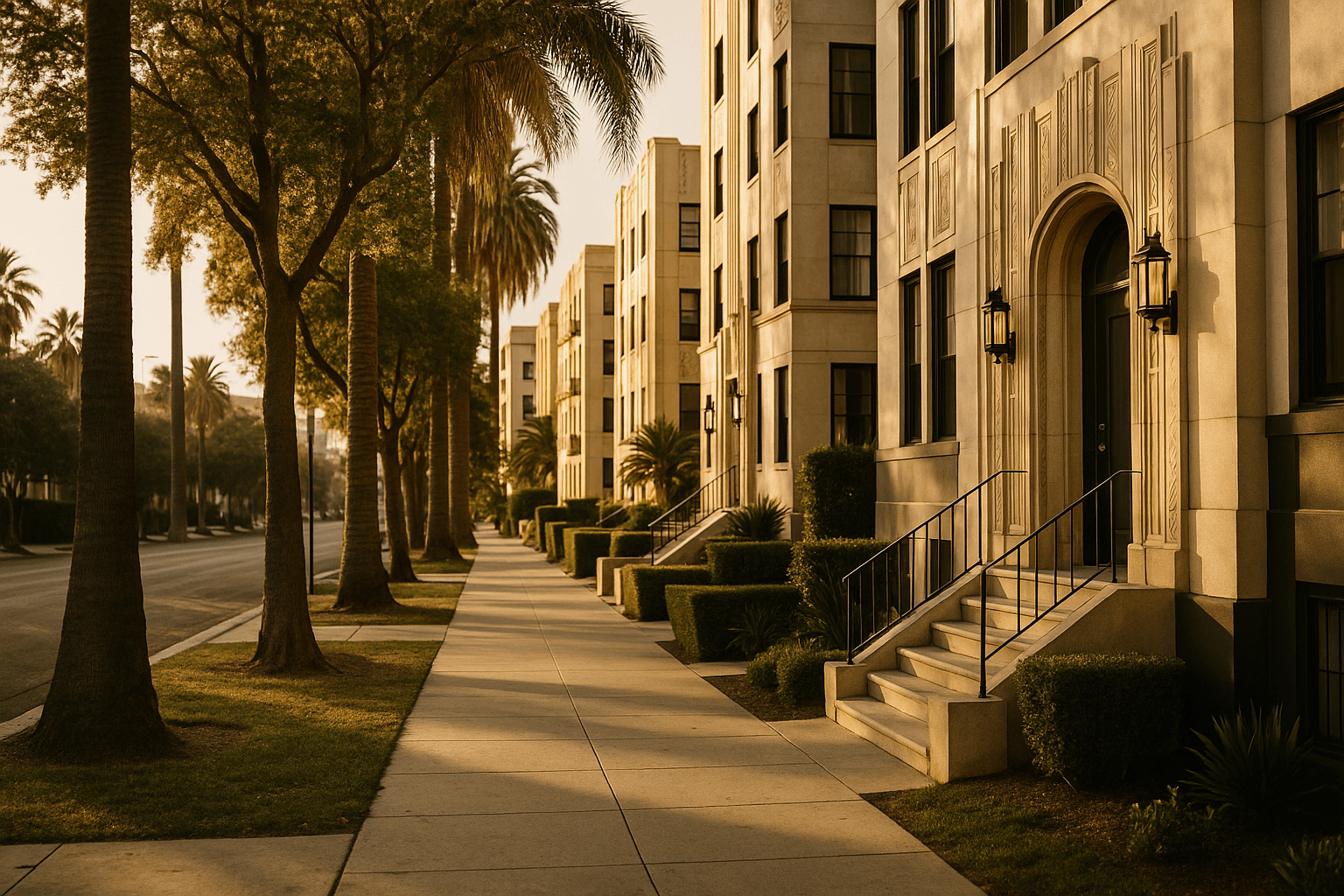
This is the Koreatown that residents experience daily — quieter than the commercial corridors but still unmistakably urban. The architecture along streets like Gramercy Place, St. Andrews Place, and Normandie Avenue reflects Los Angeles building trends from the 1920s through the present. 856 S Gramercy Dr sits on one of these residential streets, offering the best of both worlds: a walkable home base minutes from everything you have just seen, with the calm of a neighborhood block when you want it.
Extending the Tour
If you have energy for more, consider these additions:
Seoul International Park is a green space with sports fields, playgrounds, and picnic areas — a welcome contrast to the concrete of the main corridors.
Wi Spa at 2700 Wilshire Boulevard is a 48,000-square-foot Korean spa open 24/7. After three miles of walking, a soak in the hot pools and a session in the clay sauna is the perfect reward.
The Normandie Club at Hotel Normandie on Normandie Avenue serves some of the best cocktails in Koreatown. If your tour extends into the afternoon, this is where you end it.
Practical Details
Distance: Approximately 3 miles (the core loop), up to 4.5 miles with extensions.
Time: 2 to 3 hours at a moderate pace with food stops.
Start Point: Wilshire/Western Metro station (Metro D Line).
Best Days: Saturday or Sunday morning, starting around 10 AM.
Parking: If you must drive, the Koreatown Galleria offers parking. But the best way to experience this tour is on foot from the start.
Why Walk Koreatown
Walking Koreatown reveals layers that you miss from a car window. The hand-painted signs above second-floor businesses. The smell of charcoal from a BBQ restaurant venting onto the sidewalk. The sound of Korean conversations mixing with Spanish and English at a crosswalk. The sudden quiet of a residential side street after the chaos of Western Avenue.
Living at 856 Gramercy means this entire tour is your daily life. The landmarks become your landmarks. The food stops become your regular spots. The neighborhood reveals itself one walk at a time.
Schedule a tour of 856 Gramercy and start discovering Koreatown on foot.
Looking for an apartment in Koreatown?
Explore available units at The Gramercy — new luxury apartments with modern amenities.
View Available Units