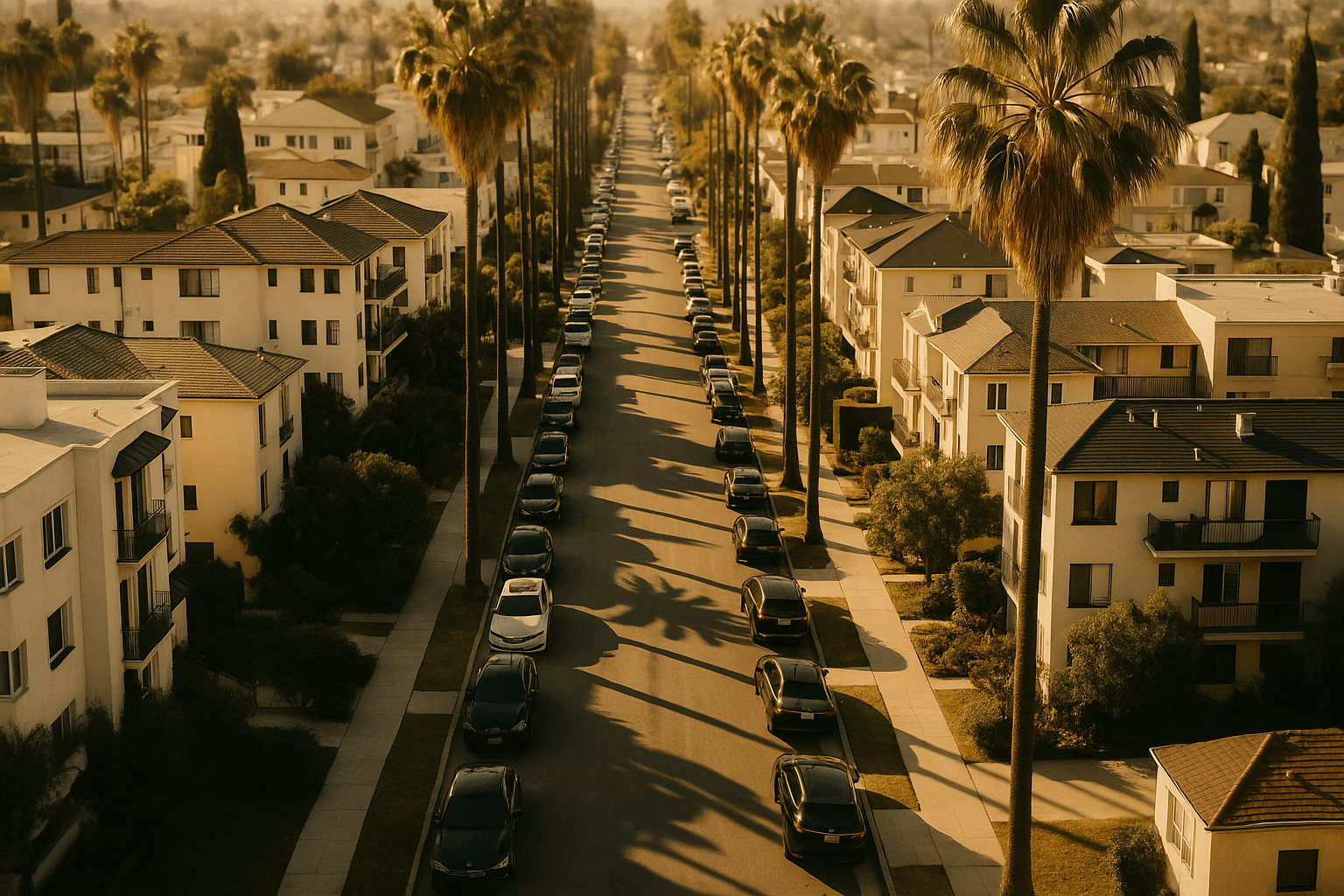
Koreatown Parking Survival Guide — Tips for Residents
2026-03-17 · The RFC Group
Koreatown Parking Survival Guide — Tips for Residents
Parking is the single most discussed pain point among Koreatown residents. The neighborhood is the densest in Los Angeles County — 120,000 residents packed into 2.7 square miles — and the parking infrastructure was designed for a fraction of that population. Add the thousands of daily visitors drawn to K-Town's restaurants, bars, and spas, and you have a situation that requires strategy, patience, and realistic expectations.
This guide covers everything a Koreatown resident needs to know about parking — the rules, the costs, the alternatives, and the honest case for going car-free.
Street Parking Rules
Street parking in Koreatown is governed by a combination of meters, time limits, permit zones, and street sweeping schedules. Understanding these rules is the difference between free parking and a $73 citation.
Meters
Parking meters in Koreatown charge between $0.50 and $6.00 per hour depending on the block and traffic volume. High-traffic commercial corridors like Wilshire Boulevard and Western Avenue tend toward the higher end of that range. Residential side streets, where metered, are generally cheaper.
Meters operate Monday through Saturday from 8 AM to 8 PM in most areas. Sundays are free at metered spots, which is one of the few genuine parking bargains in the neighborhood. The City of LA accepts payment via coin, credit card, and the ParkMobile app — download ParkMobile before you need it, because fumbling with the app for the first time while double-parked is not a good experience.
Time Limits
Many Koreatown streets have one-hour or two-hour time limits during business hours, even where there are no meters. These limits are enforced by parking enforcement officers who chalk tires or use digital tracking. Getting a $73 ticket for overstaying a two-hour limit is one of the most common and most avoidable costs for new residents.
Read the signs carefully. Koreatown parking signs are notoriously dense — a single pole might have three or four signs stacked vertically, each with different rules for different times and days. Take a photo of the sign when you park so you have a reference.
Permit Parking Zones
Several residential areas in Koreatown are designated as preferential parking zones, which means street parking is restricted to permit holders during certain hours (typically overnight, from 8 PM to 8 AM). If you live in one of these zones and park on the street, you need a residential parking permit from the LA Department of Transportation.
The permit costs approximately $34 per year and requires proof of residency (lease, utility bill) and vehicle registration. The permit does not guarantee you a spot — it just means you will not get ticketed for parking overnight. On popular blocks, finding an open spot even with a permit can take 15 to 20 minutes of circling.
Street Sweeping
Street sweeping schedules are posted on signs and enforced rigorously. Missing a street sweeping day results in a $73 ticket, and enforcement officers are precise about timing. Most blocks are swept once a week on a specific day and time window (e.g., Monday 8 AM to 10 AM).
Add your block's sweeping schedule to your phone calendar with a recurring alert. This single habit will save you hundreds of dollars per year.
Garage and Lot Parking
For residents who need guaranteed parking, monthly garage and lot rentals are the most reliable option.
Monthly Parking Costs
- Surface lots: $95 to $120 per month for uncovered spots in surface lots. These are the most affordable option but offer no weather protection and limited security.
- Covered garages: $300 to $350 per month for a covered, secured parking space in a commercial or residential garage. This is the typical range for standalone parking garages in the Koreatown core.
- Apartment building parking: Many Koreatown buildings charge $100 to $300 per month for parking on top of rent. Older buildings may have no parking at all, while newer developments sometimes include it.
The total annual cost of monthly parking ranges from $1,140 (cheapest surface lot) to $4,200 (premium covered garage). This is a significant line item in your housing budget, and it is one that many renters fail to account for when comparing apartment costs across neighborhoods.
Notable Parking Garages
The parking structures attached to Koreatown Galleria (Olympic and Vermont locations) and Madang Plaza (H Mart) offer validated parking for shoppers and diners. Validation typically covers two to three hours, which is useful for restaurant visits and grocery shopping. Some residents strategically park in these structures when visiting nearby businesses, stretching their validation across multiple errands.
Several standalone parking garages along Wilshire Boulevard and Western Avenue offer monthly rental agreements. Rates and availability fluctuate, so call ahead rather than relying on online listings, which tend to be outdated.
The Real Cost of Owning a Car in Koreatown
Before committing to a car in Koreatown, run the full numbers:
- Monthly parking: $100 to $350
- Car insurance (LA average): $200 per month ($2,400/year)
- Gas: $150 to $200 per month
- Maintenance and repairs: $100 per month (averaged)
- Registration and fees: $25 per month (averaged)
Total monthly cost of car ownership in Koreatown: $575 to $875
Total annual cost: $6,900 to $10,500
That is $6,900 to $10,500 per year that could be redirected toward rent, savings, or quality of life. For a neighborhood with a Walk Score of 93 and Metro rail access, the question is not whether you can afford a car — it is whether you actually need one.
The Case for Going Car-Free
Koreatown is one of the few neighborhoods in Los Angeles where going car-free is genuinely practical rather than aspirational. Here is why:
Walk Score: 93
A Walk Score of 93 means that nearly all daily errands — groceries, dining, coffee, pharmacy, bank, laundry — can be accomplished on foot. H Mart is a 10-minute walk from most Koreatown apartments. Korean BBQ is a 5-minute walk. The Metro station is within walking distance. You do not need a car for the tasks that define daily life.
Metro D Line
The D Line connects Koreatown to downtown LA (15 minutes), and starting May 2026, the extension reaches Beverly Hills (21 minutes). Phase 2 in 2027 adds Century City and eventually Westwood/UCLA. For commuters working in any of these areas, the Metro eliminates the need for a car entirely.
The Wilshire/Western and Wilshire/Vermont stations are both accessible from the 856 Gramercy neighborhood, providing direct rail connections without a transfer.
Rideshare for the Rest
For trips that are not covered by walking or transit — visiting friends in the Valley, heading to the beach, making an IKEA run — rideshare services fill the gap. The average Lyft or Uber ride from Koreatown to LAX costs $25 to $35. A round trip to Santa Monica runs about $40. Even using rideshare two or three times a week, the total monthly cost typically falls well below the cost of car ownership.
Bike and Scooter Infrastructure
Metro Bike Share has stations throughout Koreatown, and electric scooters from Bird and Lime are consistently available on K-Town sidewalks. For trips that are slightly too far to walk but do not justify a rideshare — say, a 15-minute bike ride to a friend's apartment in Mid-Wilshire — these micro-mobility options are practical and inexpensive.
Parking Apps That Help
If you do own a car, these apps reduce the friction of parking in Koreatown:
- SpotAngels: Free app that shows real-time parking availability, meter rates, and street sweeping schedules on a map. The most useful all-in-one parking app for Koreatown.
- SpotHero: Lets you reserve parking spots in garages and lots in advance, often at discounted rates compared to drive-up pricing.
- ParkMobile: The official app for paying LA parking meters from your phone. Lets you extend your time remotely, which means fewer tickets from expired meters.
- Parkopedia: Comprehensive database of parking garages, lots, and on-street options with pricing information.
Restaurant Parking Tips
Dining out in Koreatown requires parking awareness. Here are practical tips:
Valet
Many Koreatown restaurants offer valet parking for $3 to $5 (plus tip). This is often the most practical option for dinner, especially on weekend nights when street parking is scarce. Tip $2 to $3 on retrieval — it is expected and keeps the system running smoothly.
Validated Parking
Some restaurants in shopping plazas offer validated parking in the building's garage. Ask when you make a reservation or when you arrive. The validation typically covers two to three hours, which is plenty for a meal.
Walk to Dinner
The simplest solution is also the best. If you live within walking distance of Koreatown's restaurant corridor — as residents of 856 S Gramercy Dr do — parking becomes irrelevant for the most common type of neighborhood outing. Walk to dinner, walk to the bar, walk home. No meter, no ticket, no valet tip.
Why 856 Gramercy's Included Parking Matters
In a neighborhood where monthly parking costs $100 to $350 and street parking is a daily headache, having parking included with your apartment is a genuine financial and lifestyle advantage. At 856 S Gramercy Dr, residents do not need to budget separately for parking or spend 20 minutes circling the block after work.
This is not a minor amenity — it is a cost savings of $1,200 to $4,200 per year compared to renting a separate parking spot, and it eliminates the most persistent source of daily stress for car-owning Koreatown residents.
Combined with the building's walkable location and proximity to Metro stations, 856 Gramercy gives residents the flexibility to own a car when they need it while also making car-free living entirely practical.
The Bottom Line
Parking in Koreatown is difficult, expensive, and not getting easier. The neighborhood's density continues to grow, and the parking infrastructure is not expanding to match. The smartest approach for new residents is a two-part strategy:
- Choose an apartment that includes parking — or at minimum, has affordable parking available on-site.
- Minimize your dependence on a car — walk, ride the Metro, use rideshare, and save driving for trips that genuinely require it.
At 856 S Gramercy Dr, both of these strategies are built into the living experience. The amenities include parking, and the neighborhood is walkable enough to make car-free daily life the default rather than the exception.
Schedule a tour of 856 Gramercy and stop worrying about parking in Koreatown.
Looking for an apartment in Koreatown?
Explore available units at The Gramercy — new luxury apartments with modern amenities.
View Available Units